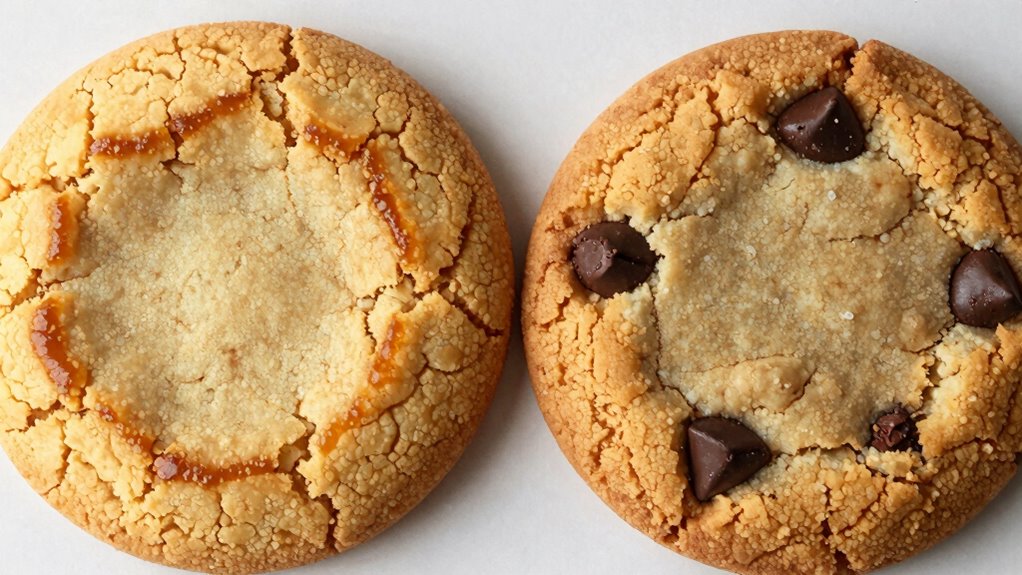
To switch your cookies from chewy to crispy with one ingredient change, focus on adjusting moisture levels. Adding extra butter or an egg increases hydration, resulting in chewier cookies with a softer interior. Reducing these ingredients makes the dough drier, causing cookies to spread more and develop a crisp exterior. Additionally, baking temperature influences texture—higher heat creates crunchiness. Small tweaks can instantly change your result, and if you keep exploring, you’ll find even more ways to perfect your cookies’ texture.
Key Takeaways
- Increasing moisture from ingredients like eggs or butter makes cookies chewier; reducing it yields crispier cookies.
- Drier doughs spread more during baking, forming a crisp exterior, while moister doughs stay thicker and chewier.
- Baking at lower temperatures and longer enhances chewiness; higher temperatures and shorter times promote crispiness.
- Adjusting hydration levels by changing key ingredients directly influences whether cookies are chewy or crispy.
- Precise control of oven temperature and baking time helps achieve the desired cookie texture with minimal ingredient changes.

Achieving the perfect cookie texture can transform a good batch into an exceptional one. It’s all about understanding how small tweaks impact the final product. Two key factors that influence whether your cookies turn out chewy or crispy are dough hydration and baking temperature. By paying attention to these elements, you can control the outcome with precision.
Dough hydration, which refers to the amount of liquid in your mixture, plays a significant role in determining cookie texture. A higher hydration level, meaning more moisture from ingredients like eggs, butter, or added liquids, encourages gluten development and creates a softer, chewier cookie. When your dough contains more water or liquid, it spreads less during baking, resulting in a thicker, more tender center. Conversely, reducing hydration leads to drier doughs that spread more easily and develop a crispier exterior. To achieve a chewy texture, consider increasing the moisture content slightly, perhaps by adding an extra egg or using more butter. If you prefer crispy cookies, keep the dough on the drier side by trimming back liquids or using less butter.
Baking temperature also plays a vital role in shaping your cookie’s final texture. Baking at a lower temperature allows the cookies to cook evenly and slowly, giving moisture time to evaporate gradually. This slow bake results in a chewier, softer cookie because the interior remains moist while the exterior firms up gently. On the other hand, higher temperatures cause the outer edges to set quickly, forming a crisp shell before the interior fully bakes through. To get crispy cookies, crank up the oven slightly—say, from 350°F to 375°F—and keep a close eye on the baking time, removing the cookies once they turn golden brown. For a softer, chewier result, stick to a moderate temperature and extend the baking time by a minute or two.
Frequently Asked Questions
How Does Baking Temperature Affect Cookie Texture?
You can affect cookie texture by adjusting the oven temperature and baking time. Higher oven temperatures make cookies crispier by quickly evaporating moisture, while lower temperatures result in chewier cookies that bake more evenly. Longer baking times at a consistent temperature also dry out cookies, enhancing crispiness. Conversely, shorter baking times keep them softer and chewier. So, experiment with oven temperature and baking time to achieve your preferred cookie texture.
Can Ingredient Substitutions Alter Cookie Chewiness or Crispiness?
Imagine biting into a cookie that’s perfectly chewy or delightfully crispy—ingredient swaps can make that happen. When you swap butter for shortening, you tweak the texture, making cookies crisper. Using more brown sugar adds moisture, giving you a chewier bite. These simple ingredient tweaks, or texture tweaks, influence how your cookies feel, letting you customize each batch to match your craving—chewy, crispy, or somewhere in between.
What Role Does Butter Versus Shortening Play in Texture Control?
Butter adds rich flavor and promotes a tender, chewy cookie texture, while shortening creates a firmer, crispier cookie due to its higher melting point. Using butter enhances flavor but shortens shelf life, leading to quicker staleness. Shortening extends shelf life and results in cookies that stay crisp longer. Your choice impacts both taste and texture, so select based on whether you want a more flavorful or longer-lasting cookie.
How Does Cookie Thickness Influence Final Texture?
Your cookie thickness substantially impacts its final texture. Thicker cookies tend to be chewier because they retain moisture and bake more evenly, especially if placed on the middle oven rack. Thinner cookies, on the other hand, become crisper due to faster heat transfer. Adjust the oven rack position accordingly—higher racks for crisp cookies, middle or lower for chewier ones. Keep an eye on thickness for your perfect cookie every time.
Are There Specific Ingredients That Enhance Crispiness Without Altering Flavor?
Yes, certain ingredient flavorings and texture enhancers can boost crispiness without changing flavor. Adding a touch of rice flour or cornstarch increases crunch, while egg whites act as natural texture enhancers, making cookies crispier. Using vanilla or almond extract enhances flavor without affecting texture. These ingredients work together to create a crispier cookie, giving you a satisfying crunch without compromising the original taste.
Conclusion
Think of your cookie as a symphony—you control the harmony by tweaking just one ingredient. Swap a bit more butter for a softer, chewier bite, or add a touch more sugar for that satisfying crunch. With this simple change, you’re the conductor shaping each note to match your mood. So, experiment confidently, and soon you’ll be crafting cookies that sing perfectly to your taste, turning every batch into a delicious masterpiece.