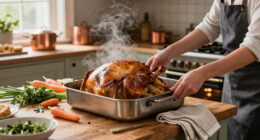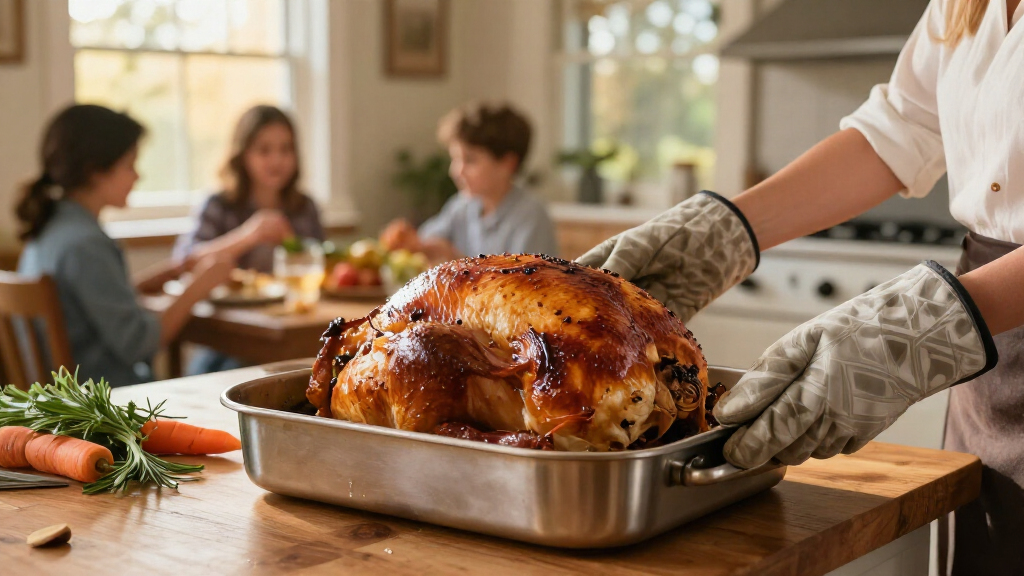
Choose a roasting pan that fits your turkey and oven, supports its weight, and gives hot air room to circulate. This guide is for home cooks preparing a Thanksgiving turkey, whether they are buying a pan or using one they already own. You will learn how to check the fit, set up the pan, roast safely, and manage drippings. Allow 30-60 minutes for selection and preparation; the turkey itself may take several hours to roast.

Get kitchen staples and gadgets delivered free with Prime
- Fast, free delivery on millions of items
- Prime Video, Amazon Music and more included
- Member-only deals all year

Cuisinart Chef’s Classic 16 In. Roasting Pan with Rack, 7117-16URP1
- ✔ Material: Stainless steel with aluminum-encapsulated base
- ✔ Finish: Uncoated stainless steel
- ✔ Dimensions: 20.7 x 12 x 4.9 inches

EWFEN Nonstick Turkey Roasting Pan with U-Shaped Rack – 17×13 Inch Extra Large Carbon Steel Roaster
- ✔ Material: Aluminized carbon steel
- ✔ Finish: Nonstick; stated free of PTFE, PFOA, cadmium, and lead
- ✔ Dimensions: 17 x 13 x 3 inches

Glad Roasting Pan Nonstick 11×15 – Heavy Duty Metal Bakeware Dish with Rack – Large Oven Roaster Tray for Baking Turkey, Chicken,…
- ✔ Material: Carbon steel
- ✔ Finish: Nonstick
- ✔ Dimensions: 15 x 10.3 x 2.8 inches, excluding handles
Difficulty: Beginner | Time: 30-60 minutes to choose and prepare the pan; roasting time varies by turkey size
What You’ll Need
Tools & Materials:
- Measuring tape or ruler
- Roasting pan with sturdy handles
- Roasting rack or suitable vegetables to lift the turkey
- Instant-read food thermometer
- Oven mitts
- Carving board and serving platter
- Fat separator or heat-safe container for drippings, if making gravy
Knowledge:
- Basic oven use
- How to read a food thermometer
- How to handle raw poultry safely
Check the turkey’s package for its weight and preparation instructions. If the turkey is frozen, thaw it safely in the refrigerator before roasting; a large bird can take several days. Do not use a pan whose handles are loose, whose coating is damaged, or whose manufacturer’s instructions prohibit oven use at your planned temperature.
Cuisinart Chef’s Classic 16 In. Roasting Pan with Rack, 7117-16URP1
For a Thanksgiving host who wants one pan to cover turkey, gravy drippings, and high-heat finishing, the Cuisinart Chef’s Classic is the most versatile pick in this group. Its uncoated stainless steel cooking surface avoids the care limits of nonstick coatings, and the stated 500°F oven limit and broiler readiness give it more headroom than the Glad and EWFEN. The removable rack lifts meat above drippings, while the aluminum-encapsulated base is designed to distribute heat evenly.Compared with the larger EWFEN, the Cuisinart has no stated maximum bird weight, so buyers should confirm that its usable cooking area suits their turkey. Its listed exterior dimensions are 20.7 x 12 x 4.9 inches, making oven and storage clearance worth measuring. Stainless steel also asks for a different cleanup routine: it is dishwasher safe, but hand-washing is recommended to protect the finish, and food may require more attention than on a coated pan. This makes it a strong all-rounder for cooks who value material durability and temperature flexibility over effortless release.
Pros:
- Uncoated stainless steel surface does not react with food or alter flavors.
- Oven-safe to 500°F and broiler-ready, above the limits stated for the other two picks.
- Includes a removable stainless steel rack and aluminum-encapsulated base.
- Induction-compatible, with riveted handles and tapered rims.
Cons:
- Hand-washing is recommended to protect the finish, despite being dishwasher safe.
- At 20.7 inches long and 12 inches wide, it may be awkward in smaller ovens or cabinets.
- No maximum turkey weight is specified in the supplied details.
Best for: Thanksgiving cooks who want an uncoated stainless steel pan with a rack, broad oven-temperature range, and induction compatibility.
Not ideal for: Anyone prioritizing nonstick food release or the simplest cleanup, or shoppers who need a clearly stated turkey weight capacity.
Bottom line: Choose the Cuisinart for the broadest stated cooking flexibility and a durable uncoated surface, provided its dimensions suit your oven and you are comfortable with hands-on cleanup.
“Choose the Cuisinart for the broadest stated cooking flexibility and a durable uncoated surface, provided its dimensions suit your oven and you are comfortable with hands-on cleanup.”
EWFEN Nonstick Turkey Roasting Pan with U-Shaped Rack – 17×13 Inch Extra Large Carbon Steel Roaster
When the Thanksgiving plan centers on a large bird, the EWFEN’s 17 x 13-inch pan and listed capacity of up to 22 pounds make its scale the main reason to choose it. Its U-shaped rack raises the roast above the drippings, and angled external handles are intended to preserve interior room while making it easier to maneuver. The aluminized carbon steel construction and nonstick finish are designed for cooks who want a roomy roaster without the uncoated-steel cleanup routine of the Cuisinart.That added capacity comes with a practical condition: measure the oven, including the path past racks and door, before committing to a pan this wide. Its 450°F maximum is lower than the Cuisinart’s and makes it less flexible for high-heat finishing. The nonstick surface may simplify release, but it also calls for care that avoids scratching; the supplied details do not specify dishwasher safety. Compared with the Glad, EWFEN gives a large bird more space, but takes up more oven and storage room.
Pros:
- Largest stated pan footprint in this lineup at 17 x 13 inches.
- Listed to accommodate turkeys up to 22 pounds.
- U-shaped rack elevates meat above grease and supports airflow.
- Food-grade nonstick coating is stated to be free of PTFE, PFOA, cadmium, and lead.
Cons:
- 450°F maximum is lower than both the Cuisinart and Glad limits.
- Large dimensions may not fit smaller ovens or storage spaces.
- Dishwasher safety is not specified in the supplied details.
Best for: Hosts cooking a larger turkey who have a full-size oven and want a nonstick pan with an elevated U-shaped rack.
Not ideal for: Cooks with compact ovens, anyone who regularly broils in their roasting pan, or buyers who need confirmed dishwasher-care instructions.
Bottom line: The EWFEN is the capacity-first choice for a large holiday bird, if your oven fits its broad footprint and its 450°F limit covers your roasting plans.
“The EWFEN is the capacity-first choice for a large holiday bird, if your oven fits its broad footprint and its 450°F limit covers your roasting plans.”
Glad Roasting Pan Nonstick 11×15 – Heavy Duty Metal Bakeware Dish with Rack – Large Oven Roaster Tray for Baking Turkey, Chicken,…
The Glad roasting pan suits cooks who need a rack-equipped roaster but want a smaller footprint than either the Cuisinart or EWFEN. At 15 x 10.3 inches, it is the most compact listed option here, which can make oven placement and cabinet storage easier. Its V-shaped iron rack promotes airflow under the roast, while the nonstick coating is intended to make food release and cleanup less demanding after dinner. The pan is dishwasher safe according to its care details.That convenience has boundaries. The Glad is not broiler safe, and its 464°F maximum sits below the Cuisinart’s 500°F rating. Its 2.8-inch depth may be less reassuring for cooks managing a particularly large bird and a generous amount of drippings; unlike EWFEN, it has no stated maximum turkey weight. Nonstick care also means avoiding abrasive cleaners and metal utensils. Compared with the EWFEN, Glad trades capacity for a more manageable size, making it the practical pick for smaller gatherings rather than the biggest Thanksgiving centerpiece.
Pros:
- Smallest stated pan dimensions in the lineup at 15 x 10.3 inches.
- Nonstick surface supports easier food release and cleanup.
- Includes a V-shaped iron rack to lift meat for airflow.
- Dishwasher safe and rated to 464°F.
Cons:
- Not broiler safe, unlike the Cuisinart.
- Nonstick surface requires avoiding abrasive cleaners and metal cutting tools.
- No maximum turkey weight is provided, and its shallow 2.8-inch depth may limit large roasts.
Best for: Smaller households and occasional hosts who want a compact nonstick roaster with a rack and dishwasher-safe care.
Not ideal for: Anyone cooking a large turkey, using a broiler, or seeking a pan that can safely accommodate metal utensils and abrasive cleanup.
Bottom line: Pick the Glad for a smaller Thanksgiving roast and convenient cleanup, but move up to EWFEN for a large turkey or to Cuisinart for broiling and higher heat.
“Pick the Glad for a smaller Thanksgiving roast and convenient cleanup, but move up to EWFEN for a large turkey or to Cuisinart for broiling and higher heat.”
As an Amazon Associate we earn from qualifying purchases.
Before You Start
Measure the oven’s usable width, depth, and height, including room for the door to close and for air to circulate around the pan. Measure the turkey after removing its packaging. The pan should hold the bird without its sides touching the walls, and its handles should remain easy to grasp with oven mitts. Check the pan’s stated capacity and temperature limits. A pan that fits on the counter may still be too large for the oven.
Keep raw turkey and its juices away from ready-to-eat foods. Wash hands and clean tools and surfaces after contact with raw poultry. Never leave a hot roasting pan unattended on an unstable surface.
Step-by-Step Instructions
Step 1: Match the pan to the turkey and oven
Set the unwrapped turkey in a tray or estimate its footprint, then compare that width and length with the inside of the roasting pan. Leave some space around the bird for air circulation and for lifting it out. Measure the pan including its handles, then compare those measurements with the oven interior. Choose a heavy-gauge metal pan with sturdy, securely attached handles; stainless steel and aluminum are common choices. If buying a disposable foil pan, choose a sturdy model and place it on a rigid baking sheet before adding the turkey.
Tip:Check the pan’s instructions for temperature limits and stovetop compatibility. Many glass pans cannot be used over a burner, and nonstick surfaces may have lower temperature limits.
Check: The pan fits in the oven with the door closed, holds the turkey without crowding, and can be lifted securely with oven mitts.
Step 2: Add a rack or a layer to lift the turkey
Place a roasting rack inside the pan so the turkey sits above the bottom and hot air can circulate. If you do not have a rack, arrange thick-cut onions, carrots, and celery in a stable layer and rest the turkey on top. Keep the bird centered and check that it does not rock or slide when you gently nudge the pan.
Tip:A rack leaves more room beneath the turkey for drippings. Vegetables can flavor gravy, but they may soften or darken during a long roast.
Check: The turkey sits securely above the pan bottom, and there is room beneath it for juices to collect.
Step 3: Prepare the turkey and pan
Follow the turkey’s package directions for thawing and removing the neck and giblets. Pat the skin dry with paper towels if the recipe calls for it, and season the bird as directed. Set the prepared turkey breast-side up on the rack or vegetables. Tuck the wing tips if the recipe instructs, and secure the legs only if the recipe calls for trussing. Wash hands, utensils, and surfaces that touched raw turkey or its juices.
Tip:Do not rinse raw turkey in the sink; splashing can spread bacteria to nearby surfaces.
Check: The turkey is fully thawed, any included parts are handled as directed, and the bird sits centered in the prepared pan.
Step 4: Set up the oven and roast
Position an oven rack low enough for the pan to sit level with clearance above the turkey. Heat the oven to the temperature in your recipe or turkey instructions. Place the pan on the rack using both hands and close the door. Roast according to the recipe’s timing as a guide, but use a food thermometer to determine when the turkey is done. Avoid opening the oven repeatedly, since heat loss can extend cooking time.
Tip:Do not rely on a pop-up timer or the turkey’s color alone. If the skin browns too quickly, follow the recipe’s advice for loosely covering it with foil.
Check: The pan is level, the oven door closes fully, and the turkey roasts without the pan touching the oven walls or heating elements.
Step 5: Check the turkey’s temperature
Near the expected end of roasting, insert an instant-read thermometer into the thickest part of the breast and the innermost part of the thigh, avoiding bone. Check the thickest part of the wing as well if your food-safety guidance calls for it. The turkey is safe when all checked locations reach at least 165°F (74°C). If any spot is below that temperature, return the bird to the oven and check again after additional cooking.
Tip:Clean the thermometer between checks if the probe has touched a part of the turkey that is not yet at a safe temperature.
Check: Each checked area reads at least 165°F (74°C), and the probe was placed in the thickest meat rather than against bone.
Step 6: Rest the turkey and collect the drippings
Use oven mitts to transfer the roasting pan to a stable, heat-resistant surface. Move the turkey to a carving board and let it rest as directed by your recipe before carving. If making gravy, pour the pan drippings into a heat-safe container or fat separator. Let the drippings settle, then separate the fat as needed. Use the pan on the stovetop only if its manufacturer says it is safe for that use.
Tip:Do not carry a heavy pan filled with hot juices by one handle. Ask for help or remove some drippings with a ladle before moving the pan.
Check: The turkey rests before carving, the drippings are collected safely, and the pan has cooled enough to handle without risk of spills.
Step 7: Clean and store the pan
Let the pan cool, then remove leftover juices and food scraps. Wash it with warm water and dish soap using a sponge or brush that suits its surface. Follow the manufacturer’s cleaning directions, especially for nonstick coatings. Dry the pan fully before storing it, and check the handles, rack, and surface for damage before its next use.
Tip:Do not pour grease down the drain. Let it cool, transfer it to a suitable container, and discard it according to local guidance.
Check: The pan and rack are clean and dry, with no loose handles, sharp damage, or flaking coating.
Common Mistakes to Avoid
- Choosing a pan based only on turkey weight. — Compare the turkey’s footprint with the pan and measure the pan, including handles, against the oven interior before roasting day.
- Using a flimsy disposable pan without support. — Set the foil pan on a rigid baking sheet before adding the turkey so the pan stays level when lifted.
- Judging doneness by color or timing alone. — Check the thickest meat with an instant-read thermometer and confirm it reaches at least 165°F (74°C).
- Moving a pan full of hot drippings by one handle. — Use both hands with oven mitts, keep the pan on a stable surface, and ladle out some liquid if the pan is too heavy.
Troubleshooting
Problem: The roasting pan does not fit in the oven.
Solution: Do not force it or let it touch the oven walls or heating elements. Use a smaller approved pan that holds the bird safely, or divide the turkey into parts and cook them in suitable pans according to a recipe.
Problem: The turkey’s skin is browning before the meat is done.
Solution: Check the recipe’s guidance and loosely cover the browned areas with foil. Continue roasting and use thermometer readings, rather than color, to decide when the turkey is done.
Problem: The pan bends or feels unstable when lifted.
Solution: Set it down on a stable, heat-resistant surface. Do not lift it while loaded; ask another adult to help stabilize a rigid baking sheet underneath or transfer the turkey and juices separately with safe utensils.
Problem: The drippings are scorched or too salty for gravy.
Solution: Do not scrape burnt residue into the gravy. Strain the usable drippings, taste before adding salt, and add unsalted stock to adjust the flavor and amount.
What Success Looks Like
The roasting pan fits fully inside the oven, supports the turkey steadily, and leaves clearance for air circulation. The turkey reaches at least 165°F (74°C) in each checked location, then rests before carving. Any drippings are handled without spills, and the cooled pan is clean, dry, and free from damage.
Next Steps
After the meal, refrigerate leftover turkey within two hours in shallow containers, following current food-safety guidance. Store the dry roasting pan where its handles and coating will not be damaged. Before the next holiday meal, check the pan’s fit against your oven and inspect its handles and rack.
Frequently Asked Questions
What size roasting pan do I need for a Thanksgiving turkey?
Choose a pan that holds the turkey without crowding and fits inside your oven with the door closed. Turkey weight alone does not determine fit, so compare the bird’s footprint with the pan and check the pan’s outside measurements, including handles.
Can I roast a turkey in a disposable foil pan?
Yes, if the pan is rated for oven use and large and sturdy enough for the bird. Put it on a rigid baking sheet before adding the turkey, and use both hands or another person’s help when moving it.
Do I need a roasting rack?
A rack helps lift the turkey above the juices and lets hot air circulate. If you do not have one, use a stable layer of thick-cut vegetables as a base, provided your recipe allows it.
Can I use the roasting pan to make gravy on the stove?
Only if the manufacturer says the pan is safe for stovetop use. Glass, some nonstick pans, and certain other materials are not suitable for direct burner heat. If unsure, transfer the drippings to a saucepan.
How do I know when the turkey is done?
Use an instant-read thermometer in the thickest part of the breast and innermost thigh, avoiding bone. Confirm that every checked area reaches at least 165°F (74°C); do not rely on the clock, skin color, or a pop-up indicator alone.