TL;DR

Get kitchen staples and gadgets delivered free with Prime
- Fast, free delivery on millions of items
- Prime Video, Amazon Music and more included
- Member-only deals all year
An independent experimenter soaked raw chicken breast in tartrazine, the yellow-orange dye used in some foods, and reported slight translucency in thin slices. The result fell short of the effect described in a research paper, and the experiment is not evidence that the chicken is safe to eat or that the method works reliably.
An independent experimenter reported that soaking raw chicken breast in tartrazine solution made thin slices slightly translucent, allowing a grid beneath them to show through. The result was weaker than the effect described in a research paper on making biological tissue transparent, and the experimenter said a higher-concentration trial failed when dye appeared to crystallize.
In the reported test, the experimenter prepared tartrazine solutions using food dye powder and tap water, then soaked chicken breast pieces for six hours at room temperature. The middle solution was estimated at about 0.19 molar; the powder was listed as more than 80% dye, so the writer said the actual concentration could be lower. A water-soaked piece served as a control and remained opaque.
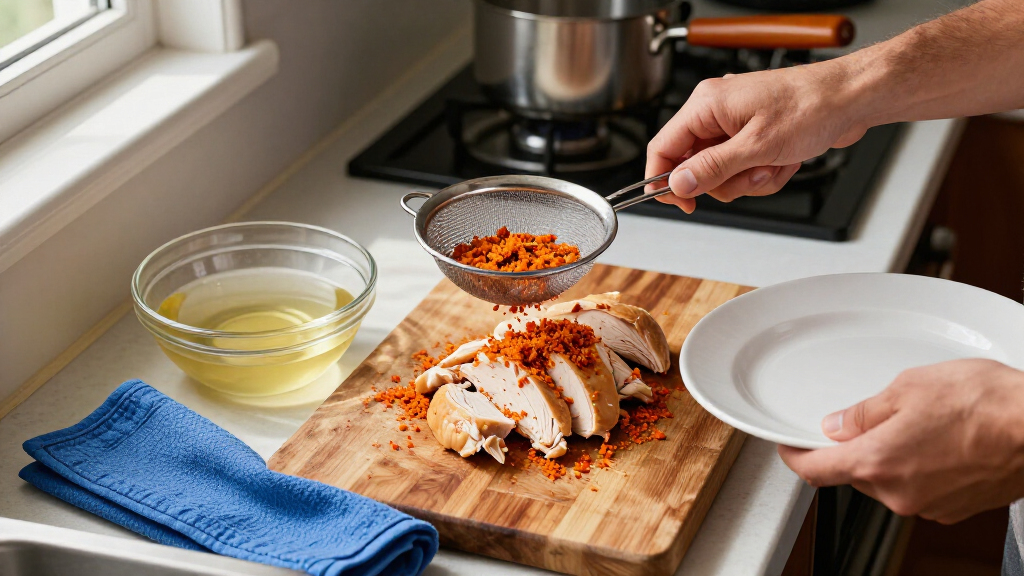
The experimenter described the treated chicken as having a gelatinous or gummy-bear-like appearance. In a later trial, chicken left in the approximately 0.19 M solution for 12 hours showed slight translucency compared with the control. A roughly 2-millimeter slice allowed a grid to be seen through it under a light, but the post did not report measurements of transparency or independent replication.
A stronger solution, estimated at about 0.56 M, did not produce a usable result: the writer said the dye appeared to crystallize on the chicken. The reported experiment used different conditions from the cited paper, which the post says used 0.62 M tartrazine, a temperature of 40 degrees Celsius and a machine shaker. The writer said they lacked suitable equipment and a way to conduct that procedure safely.
A home experiment in tissue optics
How to Make Chicken Look Transparent with Dorito Dust
A reported tartrazine trial made thin raw chicken slices slightly translucent. The effect was limited, unmeasured, and does not show that the method is reliable—or safe to eat.
01 / What happened
A small visual effect, with a clear limit
The observation comes from an informal home replication described in the supplied post.
Slight translucency
After soaking, thin slices reportedly let a grid show through under a light. The chicken was described as gelatinous or gummy-bear-like.
Still opaque
A separate water-soaked piece remained opaque, according to the writer. That comparison is useful, but it does not prove the cause.
No usable result
A solution estimated near 0.56 M reportedly left dye crystals on the chicken, so the trial did not yield a clear transparency result.
02 / Evidence snapshot
What the post reports
Qualitative observations only; bar lengths are illustrative summaries, not measured transparency values.
The post gives no calibrated light-transmission measurements, repeated controlled trials, or independent confirmation. Visual appearance can vary with thickness, lighting, handling, concentration, and soak time.
03 / Trial and paper
Related idea, different conditions
The post compares its home setup with a research paper on optical transparency in biological tissue.
| Factor | Reported home trial | Paper conditions described in post |
|---|---|---|
| Dye | Tartrazine (E102); powder listed as >80% dye | Tartrazine |
| Concentration | Middle solution estimated ≈0.19 M; approximate | 0.62 M |
| Temperature | Room temperature | 40°C |
| Mixing | Hand-stirred; no machine shaker | Machine shaker |
| Outcome | Slight translucency reported in thin raw slices | Stronger effect described by the paper, as summarized in the post |
04 / Proposed explanation
A hypothesis, not a demonstrated mechanism
Refractive-index matching
The writer proposed that tartrazine’s light absorption may shift water’s refractive index closer to that of tissue proteins and lipids, reducing light scattering.
Potential imaging relevance
The cited research approach is described as a possible way to improve fluorescence imaging in live animals. This chicken trial does not establish that outcome.
“The current model we have is that the absorbance properties of the tartrazine also shift the refractive index of water.”
— The experimenter05 / A better test
What replication would need to show
A useful follow-up would turn a visual impression into a controlled, measurable comparison.
Control conditions
Document thickness, concentration, temperature, exposure time, lighting, and handling.
Repeat samples
Run multiple treated and water-control samples using the same protocol.
Measure light
Use a defined method to quantify transmission rather than relying on appearance alone.
Handle safely
Any raw-tissue work needs appropriate laboratory safety and controlled handling.
06 / Read the result carefully
What this experiment does—and does not—say
A limited observation
The experimenter reported slight translucency in thin raw chicken slices soaked in tartrazine solution.
Reliability and cause
Reproducibility, the proposed mechanism, and practical imaging value remain unestablished.
Food safety
This is not a cooking method. Dye soaking does not establish that raw chicken is safe to eat.
07 / Key questions
Quick answers
Did the chicken become transparent?
The writer reported slight translucency in thin slices, not full transparency. The reported result was weaker than the effect described in the paper.
What is tartrazine?
A yellow-orange dye also known as E102 or C.I. 19140. The powder’s listed dye content was above 80%, making concentration estimates approximate.
Why use a water control?
It provided a comparison: the writer said the water-soaked chicken remained opaque. A control helps frame an observation but does not prove its cause.
Is this a way to prepare chicken for eating?
No. The report describes an experiment on raw chicken and does not establish food safety. The samples should not be treated as edible.
Has the explanation been confirmed?
No. Refractive-index change was suggested by the experimenter as a possible explanation; the home trial did not demonstrate the mechanism.
What would strengthen the evidence?
Repeated controlled trials, documented sample conditions, and a calibrated way to measure light transmission, with appropriate lab safety.
A Low-Cost Test of Tissue Imaging
The experiment is an informal attempt to reproduce a technique that could affect how biological tissue is viewed. The post says the research approach may improve fluorescence imaging in live animals by making tissue more transparent. If adapted and validated for suitable settings, related methods could help researchers observe internal structures with less obstruction.
The result may interest independent scientists because it uses readily available dye and basic equipment, but the post demonstrates only a limited visual effect in raw chicken. It does not establish that this procedure improves microscopy, works on living tissue, or can be used safely outside a controlled laboratory. The gap between the reported outcome and the paper’s stronger effect is a reason to treat this as a preliminary demonstration, not a validated technique.
As an affiliate, we earn on qualifying purchases.
The Research Method and Home Trial
The experimenter said a friend, Adaobi Adibe, suggested the project and shared a paper titled “Achieving optical transparency in live animals with absorbing molecules.” The post describes the paper’s approach as using tartrazine to make biological tissue, including chicken breast, more transparent. The experimenter credited Adibe for the suggestion; that attribution does not establish that she conducted or verified the test.
Tartrazine, also known as E102 or C.I. 19140, is a yellow-orange dye. The powder used in the trial was listed as having more than 80% dye content. The writer prepared solutions by weighing powder and water, stirring at room temperature, and soaking thin chicken pieces. Because the powder was not pure dye and the solution volume was estimated, the stated molarities were approximate.
The post proposes that tartrazine’s light-absorbing properties may alter water’s refractive index, bringing it closer to that of proteins and lipids and reducing light scattering. This is presented as the writer’s current explanation, not as a mechanism demonstrated by the home experiment. The research paper’s described conditions differed from the trial: the writer did not use its higher concentration, warmer temperature or shaker setup.
““I got partial transparency but not to the degree of the paper.””
— The experimenter
Limits of the Transparency Result
The post does not provide calibrated measurements of how much light passed through the chicken, or say whether the result was repeated across multiple samples under controlled conditions. The dye’s stated purity was above 80%, and the writer acknowledged that this creates uncertainty about the solution’s true concentration. It is also unclear how much the sample’s thickness, lighting, soaking time or handling affected what could be seen.
The reported chicken was raw. The post says the experimenter discarded the samples and refers to Salmonella as a risk; nothing in the report establishes that soaking in dye makes chicken safe to eat. The 12-hour trial was covered in test tubes to reduce food-safety risk, but it was still held at room temperature. The source does not describe a validated food-safety procedure, and the experiment should not be treated as food preparation guidance.
It remains unknown whether the home result can be reproduced, whether the proposed refractive-index explanation accounts for it, or whether the method can improve imaging in a practical setting. The source material contains no external assessment of the experiment or independent confirmation of its observations.
Replication and Measurement Needed
The experimenter said a more ambitious replication was planned, but the post does not give a timetable or specify the planned protocol. The next useful step would be a controlled comparison with clearly documented sample thicknesses, dye concentrations, temperature and exposure time, alongside repeat trials and a way to quantify light transmission.
Any further work involving raw tissue would also need appropriate laboratory safety procedures and controlled handling. The writer’s stated goal is to test whether inexpensive methods can help independent researchers observe biological structures. Whether this approach can meet that goal remains to be shown.
Key Questions
Did the chicken become transparent?
The experimenter reported slight translucency in thin slices soaked in an approximately 0.19 M tartrazine solution. The result was not as strong as the effect described in the cited paper, and the chicken was not fully transparent.
What is tartrazine?
Tartrazine, also called E102, is a yellow-orange food dye. The powder used in this trial was listed as more than 80% dye, which means the experimenter’s estimated solution concentrations were approximate.
Why did the experimenter use a water control?
A separate piece of chicken was soaked in water for comparison. The writer reported that the control remained opaque, while the treated sample showed some translucency. That comparison is useful but does not by itself prove the effect or establish its cause.
Is this a safe way to prepare chicken for eating?
No. The report describes an experiment on raw chicken, not a cooking method, and it does not establish food safety. The samples should not be treated as edible; raw poultry should be handled safely and cooked to a food-safe internal temperature.
What is the proposed explanation for the effect?
The experimenter suggested that tartrazine may change water’s refractive index, making it closer to the refractive index of proteins and lipids in tissue and reducing light scattering. The post presents this as a proposed model, not a mechanism confirmed by the home trial.
Source: Hacker News
NFL season / tailgating Picks
team gear
As an affiliate, we earn on qualifying purchases.