
TL;DR

Get kitchen staples and gadgets delivered free with Prime
- Fast, free delivery on millions of items
- Prime Video, Amazon Music and more included
- Member-only deals all year
A science writer reported that chicken breast soaked in a tartrazine solution became slightly translucent, allowing a grid beneath a thin slice to show through. The informal test did not match the stronger transparency described in a research paper, and the writer said the chicken was discarded rather than eaten.
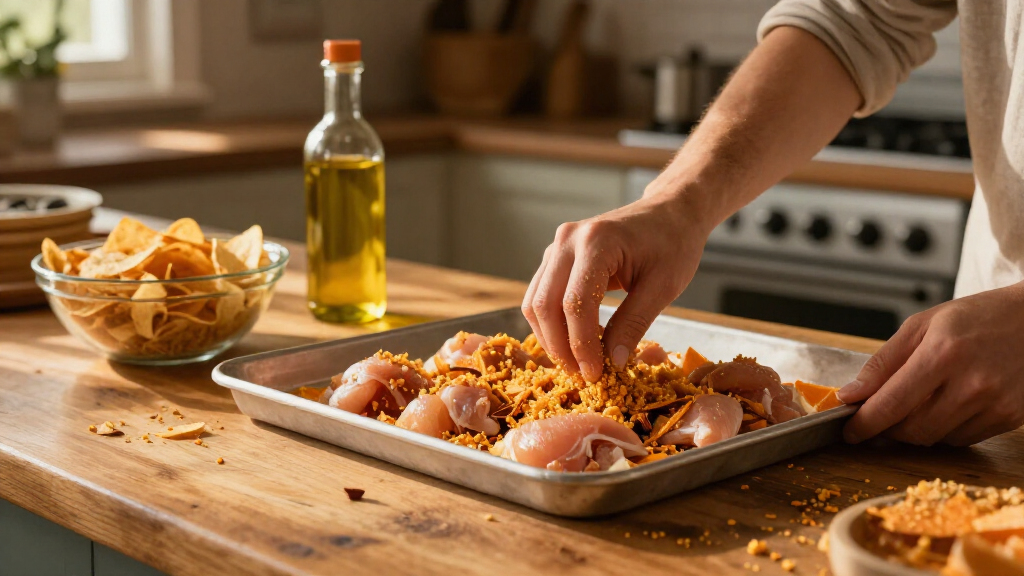
A home experiment reported by Casual Physics Enjoyer found that chicken breast soaked in tartrazine, a yellow food dye also associated with Doritos, became slightly translucent under a light. The result was limited: a grid beneath a thin slice could be seen in places, but the writer said the sample did not become as transparent as tissue in the research paper they were trying to replicate.
The writer said they soaked chicken breast in a solution described as approximately 0.19 molar tartrazine for six hours at room temperature. The piece used for the clearest demonstration was about 2 millimeters thick, cut from a thicker slice. In an image taken with a desk light, grid lines underneath were visible through part of the sample. The writer described its appearance as gummy or gelatinous, while saying its texture to the touch seemed unchanged.
The experiment included a water-soaked control, which remained opaque. A more concentrated solution, approximately 0.56 M, did not work as intended: the writer reported that dye appeared to crystallize on the chicken. In a separate trial, chicken soaked for 12 hours in the lower-concentration solution showed some visible translucency compared with the control, though the writer said the difference was difficult to capture on camera.
The post says the dye powder was listed as more than 80% dye content, leaving uncertainty about the precise concentration. The writer also noted that the original research used a higher concentration, a temperature of 40 degrees Celsius and a shaker—conditions they did not reproduce because they lacked the equipment and could not identify a way to do so safely. The tested chicken was discarded; the writer warned against eating it because of the risk of Salmonella.
A Low-Cost Route to Tissue Imaging
The experiment is an informal attempt to make a research technique more accessible. The source post says tissue transparency methods can help researchers image structures inside biological samples, and the writer sees potential for independent scientists to examine tissue with relatively accessible equipment. The reported result, however, is a preliminary visual observation, not evidence that this specific home procedure produces a reliable imaging method.
For readers, the distinction matters: the experiment used food-associated dye, but it involved raw chicken and was not a cooking or food-preparation method. The author did not eat the sample and explicitly raised the food-safety risk. The report also does not establish that the chicken was safe to handle or that the procedure can be repeated consistently.
Products Worth Considering

KitchenAid KSMPRA 3-Piece Pasta Roller and Cutter Set

Vitamix Ascent X2 SmartPrep Kitchen System, Black

Instant Pot RIO Wide 7.5-Quart 7-in-1 Electric Pressure Cooker
As an affiliate, we earn on qualifying purchases.
The Research Behind the Test
The post describes a paper titled “Achieving optical transparency in live animals with absorbing molecules,” whose authors used tartrazine to make biological tissues, including chicken breast, more transparent. The writer says the paper’s protocol used a 0.62 M solution, a temperature of 40 degrees Celsius and mechanical shaking. Their own trial differed in concentration and conditions, so it was not a full replication.
In the writer’s proposed explanation, tartrazine’s light-absorption properties also affect the refractive index of water. The idea is that bringing the refractive index of water closer to that of proteins and lipids in tissue could reduce light scattering and improve transparency. The post presents this as a current model, with a fuller explanation promised later—not as a mechanism demonstrated by the home test itself.
The writer credited Adaobi Adibe with suggesting the experiment and said they planned a more ambitious replication. The post also identifies the dye supplier and provides solution-preparation details, while acknowledging that the powder’s purity means the actual dye concentration may be lower than the nominal calculation.
“I got partial transparency but not to the degree of the paper.”
— Casual Physics Enjoyer
Limits of the Home Experiment
The post does not report measurements of how much light passed through the chicken, a quantified comparison with the original paper, or repeated trials sufficient to establish reproducibility. The observed effect was described visually, and the writer said it was difficult to capture in photographs. It is also unclear how much of the dye powder was active tartrazine: the listed content was above 80%, not a precise purity figure.
The 12-hour trial involved raw chicken left at room temperature, even though it was covered. The writer said the covering was intended to mitigate food-safety risk, but the post provides no temperature-control or microbiological testing. It does not establish that the sample was safe to handle or consume, and the writer says the pieces were thrown away. The original paper’s methods and results are not independently assessed in the post.
A More Controlled Replication
The writer said they intended to attempt a more ambitious replication, but the source post does not give a date or detailed plan. Any follow-up would need to clarify how it differs from the first test and whether it can safely reproduce the paper’s conditions, including its higher dye concentration, 40-degree temperature and shaking.
For now, the reported finding is limited to partial, visually observed translucency in thin chicken breast under light. Further testing would be needed to measure the effect, check repeatability and determine whether the proposed refractive-index explanation accounts for the result.
Key Questions
Did the chicken become completely transparent?
No. The writer reported partial translucency, with a grid visible through some areas of a thin slice. They said the result did not match the stronger transparency described in the research paper.
What is Dorito dust in this experiment?
The experiment used tartrazine, a yellow food dye that the post associates with Doritos. It used purchased dye powder mixed with water, not crushed snack chips.
Was the chicken safe to eat?
The writer did not eat it and said the samples were discarded, citing the risk of Salmonella. This was an experiment with raw chicken, not food-safety guidance or a recipe.
Why might tartrazine make tissue look clearer?
The writer proposed that tartrazine may change water’s refractive index, bringing it closer to that of proteins and lipids in tissue and reducing light scattering. The post presents this as a proposed explanation, not a mechanism proven by the home experiment.
What happens next?
The writer said they hoped to attempt a more ambitious replication. No timetable or detailed follow-up protocol was provided in the source post.
Source: hn