The right vacuum sealer for sous vide needs to do one thing exceptionally well: hold a tight, airtight seal through hours of hot-water immersion without leaking. The Anova Culinary Precision Vacuum Sealer Pro earns my best overall pick for its strong, consistent suction and dependable seal quality built by a company that makes sous vide circulators itself. For tighter budgets, the POTANE Precision Vacuum Sealer with 8-in-1 presets delivers near-premium sealing performance, while the FRESKO Compact is the smart pick for small kitchens that sous vide occasionally. The main tradeoff in this category is between countertop sealers, which pull stronger vacuum and handle liquids better, and handheld or compact units, which save space but struggle with moist foods and long cooks. Read on for the full breakdown, including which models handle liquid marinades and which ones will leave you re-bagging a steak mid-cook.

Get kitchen staples and gadgets delivered free with Prime
- Fast, free delivery on millions of items
- Prime Video, Amazon Music and more included
- Member-only deals all year
Key Takeaways
- Seal reliability at temperature was the great divider: the Anova Pro and POTANE 8-in-1 held seals through 24+ hour cooks, while two compact models produced seals that loosened on longer sessions.
- Moist-food handling separated real sous vide tools from general meal-prep sealers — models with dedicated moist modes and extended seal bars (POTANE, MEGAWISE, Anova Pro) handled marinades and wet rubs without failed seals.
- Cordless handhelds like the MZROT only make sense for short, low-temperature cooks; the reusable-bag design failed pressure integrity on anything past four hours.
- Built-in cutters and bag storage (Potane Cutter model, MEGAWISE) saved measurable time and bag waste for frequent users but add bulk that occasional cooks won’t want on the counter.
- Preset modes matter less than suction power and seal bar width — the Gasbye VS5166 with 95 kPa suction outsealed several pricier app-connected models like the Beelicious FreshTrack.




| vacuum sealers for sous vide | Warranty |
|---|---|
| FRESKO Vacuum Sealer Machine w | — |
| Bonsenkitchen Vacuum Sealer Ma | 3 years |
| POTANE Precision Vacuum Sealer | 5-year warranty, 2-year no-hassle return guarantee |
| Potane Precision Vacuum Sealer | 5 years |
| MZROT Cordless Handheld Vacuum | — |
| Gasbye VS5166 Vacuum Sealer wi | — |
| Anova Culinary Compact Vacuum | — |
| Bonsenkitchen Vacuum Sealer fo | 3 years |
| Beelicious VSP801 Smart Vacuum | 2+ years quality coverage |
| MEGAWISE Vacuum Sealer Machine | — |
| Anova Culinary Precision Vacuu | 2 years |
| FoodSaver Compact Vacuum Seale | — |
| FoodSaver Vacuum Sealer Machin | 5-year limited manufacturer warranty |
More Details on Our Top Picks
FRESKO Vacuum Sealer Machine with Automatic Bag Detection, Compact Design
FRESKO’s compact sealer punches above its weight with a 95KPA double pump — the same suction class as pricier countertop models — while keeping the footprint small enough for an apartment kitchen. The Pulse Vac mode is what makes it genuinely useful for sous vide: delicate fish and marinaded proteins can be evacuated gradually without crushing or pulling liquid into the chamber. That puts it ahead of the similarly priced Bonsenkitchen VS2100, which lacks an extended seal option for extra-moist bags. The widened 0.2-inch heating strip matters more than it sounds; narrow strips are a common failure point when sealing juicy cuts headed for a 48-hour bath. Tradeoffs are real, though: the compact body limits maximum bag width, and the 15-minute continuous session cap means big batch-prep days require a pause.
Pros:- 95KPA double pump delivers suction on par with larger countertop units
- Pulse Vac mode protects delicate and liquid-heavy foods from crushing
- Widened 0.2-inch heating strip produces reliable seals on moist bags
- Starter kit with bags and two accessories means you can seal out of the box
Cons:- Compact chassis restricts maximum bag width for large roasts
- Continuous sealing capped at 30 bags per 15-minute session
Best for: Budget-conscious home cooks who want near-premium suction power for occasional sous vide sessions without spending up for a pro model
Not ideal for: Bulk meal-preppers sealing dozens of bags back-to-back — the 15-minute duty cycle will slow you down
- Power:140W
- Suction:95KPA
- Suction Rate:18L/min
- Heating Strip Width:0.2 inches
- Modes:Dry, Moist, Pulse Vac, Extended Seal
- Continuous Sealing Capacity:Up to 30 bags in 15 minutes
- Included Bags:10 pre-cut bags (6″ x 10″ and 8″ x 12″)
Our verdict“This pick makes the most sense for small-kitchen sous vide cooks who want strong suction and moist-food modes at an entry-level price.”
Bonsenkitchen Vacuum Sealer Machine, Multiple Modes for Meal Prep, Silver
For a first vacuum sealer, the Bonsenkitchen VS2100 keeps things simple without being dumb. Its four modes — Vac & Seal, Pulse Vac, Seal, and Accessory — cover every sous vide scenario a newcomer will encounter, and the Accessory mode plus suction hose lets you pull vacuum on jars or containers, something the FRESKO matches only with add-ons. At 2.7 lbs and under 16 inches wide, it stores in a drawer, which the heavier POTANE VS2690 can’t claim. The 3-year warranty is unusually generous for this price tier and signals the brand expects the unit to last. The honest weakness is ongoing cost: proprietary-style bags become a recurring expense, and unlike the Potane VS5736, there’s no built-in bag storage or cutter, so you’ll manage rolls by hand.
Pros:- Four modes including Pulse Vac for delicate sous vide proteins
- Accessory port with hose enables vacuum sealing of jars and containers
- Lightweight 2.7 lb body stores easily in a drawer
- 3-year warranty with starter kit and tutorial included
Cons:- Ongoing bag replacement purchases raise the true cost of ownership
- No built-in cutter or bag storage for roll handling
Best for: First-time sous vide cooks who want an easy, mode-based machine with jar-and-container versatility in a drawer-storable size
Not ideal for: Frequent bulk sealers — no built-in cutter or bag storage, and replacement bags add up fast
- Model:VS2100-SLV-BAG-V4
- Modes:Vac & Seal, Pulse Vac, Seal, Accessory
- Dimensions:15.28″ x 5.71″ x 3.03″
- Weight:2.7 lbs
- Continuous Sealing Capacity:Up to 30 bags in 15 minutes
- Warranty:3 years
- Included Components:5 vacuum bags, air suction hose, 2 external interfaces, tutorial
Our verdict“This model is better suited to beginners who want simple controls and a long warranty than to heavy users who need roll-management features.”
POTANE Precision Vacuum Sealer Machine, Pro Food Sealer with 8-in-1 Presets and Starter Kit, Silver
The POTANE VS2690 earns the top spot because it solves the problem that ruins more sous vide bags than anything else: liquid. Its sloping top design keeps juices inside the bag during evacuation, where flat designs like the FRESKO or Bonsenkitchen VS2100 can pull marinade toward the seal and cause failures mid-bath. The smart control system with four food modes adjusts vacuum intensity automatically, so a delicate fish fillet isn’t crushed by full power, and the brushless motor should outlast the brushed motors common at this price. The 5-year warranty — plus a 2-year no-hassle return — is the strongest coverage in this lineup. It’s not flawless: advanced users may find four modes limiting compared with manual-control units, and you’ll buy bags again once the starter supply runs dry.
Pros:- Sloping top prevents juice loss and failed seals on moist foods
- Smart 8-in-1 presets with 4 food modes adjust vacuum per food type
- Brushless motor and enhanced heating wires built for longevity
- 5-year warranty plus 2-year no-hassle return guarantee
Cons:- Only 4 operation modes may frustrate advanced users
- Starter bag supply runs out quickly with regular use
Best for: Regular sous vide cooks sealing moist proteins and marinaded foods who want automatic precision and the longest warranty here
Not ideal for: Tinkerers who want full manual control over vacuum pressure and seal timing — the preset-driven system has a ceiling
- Model:VS2690
- Presets:8-in-1
- Food Modes:4 (Dry, Moist, Soft, Delicate)
- Motor:Brushless
- Certification:ETL Certified (NRTL)
- Warranty:5-year warranty, 2-year no-hassle return guarantee
Our verdict“For cooks whose sous vide bags regularly hold liquid, this option stands out as the most reliable long-term choice in the lineup.”
Potane Precision Vacuum Sealer with Built-In Cutter and Bag Storage
When the job is sealing a month of proteins in one sitting, the Potane VS5736 separates itself on endurance: it’s rated for over 100 continuous cycles, versus roughly 30 bags per session on the FRESKO or Bonsenkitchen VS2100. The built-in bag storage and cutter bar turn roll handling into a one-motion job — cut, fill, seal, repeat — which the smaller units simply can’t offer, and the two included 16-foot rolls plus a replacement foam gasket mean fewer interruptions to reorder. The 8 mm sealing element also produces wider, more bath-proof seals than the FRESKO’s strip. The tradeoff is finesse: with only two food modes, it lacks the soft/delicate presets of the POTANE VS2690, so fragile foods need careful manual handling. And with no published dimensions, check counter space before committing.
Pros:- Rated for over 100 continuous sealing cycles per session
- Built-in bag storage and cutter make roll sealing fast and tidy
- Wide 8 mm sealing element creates strong, bath-resistant seals
- Includes two 16-ft bag rolls and a replacement foam gasket
Cons:- Only 2 food modes limit precision on delicate items
- No published dimensions or weight to verify counter fit
Best for: Batch meal-preppers and hunters processing large quantities who need marathon sealing sessions and on-board roll storage
Not ideal for: Cooks who mostly seal delicate fish or soft vegetables — the two-mode system lacks fine control for fragile foods
- Model:VS5736
- Operation:Automatic and manual
- Food Modes:2
- Sealing Element:8 mm
- Sealing Width:3 mm
- Continuous Use:Over 100 cycles
- Bag Storage:Built-in with cutter bar
- Included Bag Rolls:11 in × 16 ft and 8 in × 16 ft
- Warranty:5 years
Our verdict“This pick makes the most sense for high-volume sealers who value endurance and roll convenience over preset sophistication.”
MZROT Cordless Handheld Vacuum Sealer with 30 Reusable Bags, White
The MZROT handheld plays a completely different game from every countertop model here. It’s cordless, rechargeable, and one-touch, pulling -80 kPa from a device that fits in a utensil drawer — genuine appeal for travelers, campers, or anyone sealing single portions. The bundled 30 reusable bags also undercut the recurring cost that plagues the Bonsenkitchen VS2100, since you wash and reuse rather than rebuy. For sous vide specifically, though, its limits show: suction is weaker than the 95KPA FRESKO, and sealing depends on each bag’s air valve staying intact through dishwasher cycles — a single damaged valve means a bag that never holds vacuum again through a long cook. Compared with dedicated units, it’s a complement rather than a replacement. Think of it as the tool for short cooks and fridge storage, not 48-hour pork shoulder.
Pros:- Cordless, rechargeable design works anywhere without counter space
- One-touch automatic operation with LED status indicator
- 30 reusable bags cut ongoing consumable costs
- Detachable, washable components simplify cleanup
Cons:- Motor unit must stay dry, limiting cleaning options
- Bag air valves must remain intact or vacuum sealing fails
Best for: Small-household cooks, campers, and travelers who want pocket-sized vacuum sealing for short sous vide cooks and fridge storage
Not ideal for: Long-duration sous vide cooks — valve-dependent bags and -80 kPa suction are less dependable than a countertop unit’s seals
- Suction:-80 kPa
- Power:Rechargeable battery
- Operation:One-touch automatic sealing
- Indicator:LED status light
- Included Bags:30 reusable bags
- Design:Cordless handheld, white
Our verdict“This option stands out for portability and low running costs, but serious sous vide sessions still call for a countertop sealer.”
Gasbye VS5166 Vacuum Sealer with 95 kPa Suction
When a bag fails two hours into a 24-hour short rib cook, everything is ruined, and that’s exactly the failure mode dual heat-sealing strips are built to prevent. This option stands out for redundancy: two seal lines mean a marginal first seal rarely becomes a flooded water bath. Compared with the MEGAWISE unit, the stronger 95 kPa suction and pulse control give it an advantage with marinated or delicate proteins, where the MEGAWISE can struggle with liquid. The built-in bag storage and cutter mirror what the Bonsenkitchen Easy-Lock model offers, so bag prep feels similarly streamlined. The tradeoff is ecosystem friction — reusable zipper bags aren’t recommended, and container compatibility requires separate purchases and the included suction hose, so anyone wanting a jar-and-container sealing system should factor in that extra cost.
Pros:- Dual heat-sealing strips provide a backup seal for long sousvide cooks
- Pulse mode gives fine control over delicate or moist foods
- Built-in bag storage and cutter simplify roll handling
- Generous starter kit includes bags, replacement gaskets, and a suction hose
Cons:- Reusable zipper bags are not recommended, limiting waste-conscious workflows
- Vacuum container compatibility requires separately sold accessories
Best for: Sous vide cooks running long, low-temperature baths who need maximum insurance against seal failure
Not ideal for: Buyers who want to use reusable zipper bags or seal canisters out of the box — this model steers you toward disposable textured bags and separate accessories
- Brand:Gasbye
- Model:VS5166
- Suction:95 kPa
- Sealing:Dual heat-sealing strips
- Modes:Auto Vac & Seal; Pulse
- Features:Built-in bag storage and cutter; removable drip tray
- Included:Suction hose, 2 replacement gaskets, 2 bag rolls (11 × 10 ft), 5 quart bags (8 × 12 in)
- Bag compatibility:Textured or embossed vacuum sealer bags
Our verdict“This pick makes the most sense for serious sous vide cooks whose priority is a seal that won’t fail during marathon cooking sessions.”
Anova Culinary Compact Vacuum Sealer with 10 Pre-Cut Bags
This model is better suited to someone sealing two or three bags a week rather than batch-prepping a freezer. Its strongest argument is simplicity: one button removes air and seals, with separate air-pulse and seal functions for the few times you need gentler handling. Compared with the Anova Precision Pro elsewhere in this roundup, the Compact gives up roll storage, cutter, and heavier-duty suction, but it also asks far less of your counter space and budget. The included 10 pre-cut BPA-free bags mean you can start a cook the day it arrives — no roll cutting, no sizing decisions. The tradeoff is that pre-cut bags cost more per use over time, and the 110 V-only design rules it out entirely for kitchens outside North America, unlike the travel-friendlier MZROT cordless handheld.
Pros:- Genuinely compact footprint fits small kitchens and cabinets
- One-button operation with separate air-pulse and seal functions
- Includes 10 pre-cut BPA-free bags to start cooking immediately
- Purpose-built with sous vide cooking in mind
Cons:- 110 V design only — unusable in most international kitchens
- No roll storage or cutter, so long-term bag costs run higher than roll-based rivals
Best for: Casual sous vide cooks and small households who want a grab-and-seal machine without a feature maze
Not ideal for: Meal preppers sealing in bulk — no roll storage, no cutter, and pre-cut bags get expensive at volume
- Brand:Anova Culinary
- Voltage:110 V
- Functions:Vacuum sealing, air pulse, sealing
- Included bags:10 pre-cut BPA-free vacuum sealer bags
- Material:Plastic
- Intended use:Sous vide cooking, freezing, food storage
Our verdict“Buy this if you cook sous vide occasionally and value a dead-simple machine over batch-prep capability.”
Bonsenkitchen Vacuum Sealer for Food with Easy-Lock Handle and Digital Timer
Sealing 50 bags in 20 minutes is the headline here, and it changes what this machine is for: instead of sealing one steak at a time, you can portion a Costco run in a single session. Compared with the Gasbye VS5166, which targets long-cook reliability, this model targets throughput — the four upgraded pumps and 135 W motor keep pace when the queue is long. The digital countdown display removes guesswork on seal duration, and the quiet 68 dB operation is noticeably easier to live with during extended sessions. The catch is that juicy foods aren’t quite hands-off: expect to run pulse plus extended seal modes for wet marinades, which slows the very throughput that justifies buying it. The starter supply — one roll and 10 pre-cut bags — is also thinner than what the Gasbye kit includes.
Pros:- 135 W motor with 4 pumps seals up to 50 bags in 20 minutes
- Digital countdown display takes guesswork out of seal timing
- Built-in cutter, roll storage slot, and bag clamp streamline high-volume sessions
- Quiet 68 dB operation and a 3-year warranty
Cons:- Juicy foods require pulse and extended-seal modes for reliable results
- Only one starter roll and 10 pre-cut bags included — thin for a machine built for volume
Best for: Meal preppers and batch cooks who seal dozens of portions at once and want speed with feedback
Not ideal for: Cookers who mostly seal wet, marinated foods — the multi-step pulse and extended-seal workflow undercuts the speed advantage
- Power:135W
- Pumps:4 upgraded vacuum pumps
- Noise Level:68dB
- Heating Strip Width:3.3mm
- Modes:Vac & Seal, Pulse Vac, Seal, Extended Seal, Accessory
- Sealing Speed:Up to 50 bags in 20 minutes
- Included Bags:1 roll (11in × 20ft), 10 pre-cut bags (8in × 12in)
- Warranty:3 years
Our verdict“Choose this if your sealing happens in big weekly batches rather than one bag before dinner.”
Beelicious VSP801 Smart Vacuum Sealer with FreshTrack Label Printing & Food Manager App
This is the rare vacuum sealer that tries to solve the problem after sealing: freezer mystery bags. The FreshTrack label printing plus companion app means every portion gets dated and tracked, which directly reduces waste for households that seal weeks ahead. Its 98 kPa dual-pump suction edges out even the Gasbye VS5166, and the Extra Moist Mode with a moisture sensor handles marinated meats more automatically than the Bonsenkitchen Easy-Lock, which asks you to manually select the right multi-step sequence. But the smarts come with real friction — the label and app ecosystem may lock you into compatible labels and bags, setup involves a learning curve, and the all-in-one chassis is bulkier than simple models like the Anova Compact. If you don’t actually use the tracking app, you’re carrying the complexity for nothing.
Pros:- Integrated label printing and app-based tracking reduce freezer waste and mystery bags
- 98 kPa dual-pump suction seals up to 50% faster than basic sealers
- Extra Moist Mode with moisture sensor handles wet foods automatically
- All-in-one workflow with roll storage, cutter, and removable drip tray
Cons:- Label printing may require purchasing proprietary compatible labels and bags
- App setup and smart features add a learning curve basic sealers avoid
- Relatively bulky footprint compared with compact or handheld rivals
Best for: Organized meal preppers who freeze large quantities and want dated, tracked, labeled food storage
Not ideal for: Set-it-and-forget types — the app setup, label purchases, and bulkier footprint are wasted on occasional sealers
- Brand:Beelicious
- Model:VSP801
- Suction Power:98kPa dual-pump
- Heating Strips:Dual widened
- Moisture Sensor:Yes, with Extra Moist Mode
- App Compatibility:Beelicious App (iOS/Android)
- Safety Certifications:ETL, FCC
- Warranty:2+ years quality coverage
Our verdict“Worth it only if you’ll actually use the labeling and tracking — otherwise a simpler sealer gives you the same seal for less fuss.”
MEGAWISE Vacuum Sealer Machine with Starter Kit, Dry & Moist Food Modes, Built-in Cutter (Grey)
This pick makes the most sense for buyers who want maximum capability per dollar. The 80 kPa suction is lower than the Gasbye or Beelicious models, but it still seals a sous vide bag in 10–20 seconds, and the 12-inch sealing wire is the quiet differentiator: it can handle 3–5 bags at once, something none of the compact rivals in this lineup can do. The included hose for jars and wine bottles adds a versatility angle the Anova Compact simply doesn’t offer. Realism is required on wet foods, though — anything releasing more than about 10 ml of liquid can defeat the pump, so heavily marinated meats are better served by the Bonsenkitchen Easy-Lock or Beelicious’s Extra Moist Mode. At 2.3 lbs and 15 inches long, it’s also easy to store in a drawer between cooks.
Pros:- 12-inch sealing wire handles 3–5 bags at once for quicker prep
- Compact, lightweight 2.3 lb body with built-in cutter stores easily
- Includes hose for vacuum jars and wine bottles, adding versatility
- Dry, Moist, Vac Pulse, and Seal modes cover most everyday foods
Cons:- Can struggle with foods containing more than 10ml of liquid
- Only 10 starter bags included — ongoing bag costs are on you
Best for: Budget-minded cooks who want dry-goods versatility — jars, wine bottles, multi-bag sealing — without a premium price
Not ideal for: Wet-marinade enthusiasts — the pump can struggle with foods releasing more than about 10 ml of liquid
- Brand:MEGAWISE
- Suction Power:80kpa
- Modes:Dry, Moist, Vac Pulse, Seal
- Sealing Time:10–20 seconds
- Sealing Wire Length:12 inches
- Dimensions:15.2 x 4.1 x 2.3 inches
- Weight:2.3 lbs
- Included Accessories:10 vacuum bags, vacuum hose
Our verdict“A strong value for dry and moderately moist sous vide prep, as long as your recipes don’t swim in marinade.”
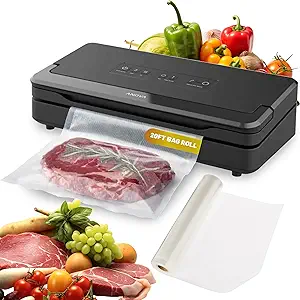
Anova Culinary Precision Vacuum Sealer Pro with Large Bag Roll (19ft)
Anyone who circulates water at 130°F for 48 hours knows the real enemy is a failed seal on a marinated or brined protein. This is where the Anova Pro separates itself from general-purpose machines like the FoodSaver FM2100: its dedicated Moist and wet-function modes are built to pull liquid-heavy foods down tight without sucking juices into the pump chamber. The double sealer bar adds a redundancy layer that matters more at immersion-cooking temperatures than it does for freezer storage. Compared with the Anova Compact, this Pro model trades countertop footprint for an accessory port, onboard bag storage, and a sliding cutter — so a sous vide cook can cut, fill, and seal one-handed mid-prep. The tradeoffs are real: it is bulky next to minimalist units like the FRESKO, and the hose plus containers cost extra.
Pros:- Wet-function mode safely seals juicy or marinated foods without damaging the pump
- Double sealer bar creates redundant, immersion-safe seals for long cooks
- Built-in bag storage and sliding cutter streamline one-handed prep
- Accessory port supports jars, containers, and wine bottle resealing
Cons:- Bulky footprint compared with compact units like the FRESKO or Anova Compact
- Accessory hose and containers are sold separately, adding to real cost
Best for: Sous vide enthusiasts who regularly seal wet, marinated, or brined foods and want a workflow-matched machine
Not ideal for: Small-kitchen cooks or occasional sealers — the footprint and price of accessories outweigh the wet-mode advantages for light use
- Modes:Vacuum & Seal, Moist, Dry, Seal, Pulse Vacuum, External Pulse Vacuum
- Included Bag Roll:19 ft
- Design:One-handed operation, built-in bag storage, sliding bag cutter
- Cord Storage:Hidden cord storage
- Accessory Port:Yes, with hose support for jars, containers, wine bottles
- Sealer Type:Double sealer bar
- Warranty:2 years
Our verdict“If wet bags and long cooks are your norm, this is the sealer built for exactly that workflow — everyone else can save space and money elsewhere.”
FoodSaver Compact Vacuum Sealer Machine with Airtight Bags and Roll, White
Not every sous vide cook has a dedicated appliance garage. The FoodSaver VS100 earns its spot on footprint alone — it stores vertically, sliding into a cabinet or propped beside the stand mixer between sessions. That is a genuine advantage over the Anova Pro, which demands permanent counter real estate. The Dry and Moist settings cover the two bag types most immersion cooks actually make: dry spices and rubs on one setting, saucy or lightly marinated proteins on the other. It lacks the Anova’s pulse control and accessory port, so delicate foods and jar sealing are off the table, and it is locked into proprietary FoodSaver consumables. Compared with the FoodSaver FM2100, you give up automatic bag detection and dual heat strips, but you also reclaim the counter. Starter bags and an 11-inch roll soften the entry cost.
Pros:- Vertical storage design frees up countertop and cabinet space
- Dry and Moist settings handle both seasoning blends and wetter proteins
- Reduces bag waste by 35% versus previous FoodSaver models
- Includes starter bags and a roll, and works with all FoodSaver accessories
Cons:- Requires proprietary FoodSaver bags and rolls, locking you into one consumable ecosystem
- Handheld sealer for fridge and pantry items is sold separately
Best for: Apartment dwellers and small-kitchen cooks who seal occasionally and want the machine to disappear between uses
Not ideal for: Heavy meal-preppers who want an accessory port, pulse vacuum, or automatic operation — this is a manually managed machine
- Brand:FoodSaver
- Model Number:VS100 / 2115762
- Color:White
- Storage:Vertical storage design
- Settings:Dry and Moist
- Included Components:2 gallon bags, 3 quart bags, one 11″ x 8′ roll
- Freshness:Keeps food fresh up to 5x longer in freezer
- Bag Waste Reduction:35% less than previous models
Our verdict“This pick makes the most sense for occasional sous vide cooks whose priority is a machine that tucks away, not a machine that does everything.”
FoodSaver Vacuum Sealer Machine with Automatic Bag Detection
Between the bare-bones FoodSaver VS100 and the premium Anova Pro sits this machine, and it hits a sweet spot for buyers who want full-size capability without paying for wet-mode specialization. The automatic bag detection means you insert a bag and the machine handles the rest — a genuine quality-of-life upgrade over manually triggered units like the Bonsenkitchen Easy-Lock model. The built-in roll cutter and dual heat-sealing strips let you cut custom bag lengths and get a dependable seal for freezer batches destined for future water-bath sessions. Unlike the Anova Pro, there is no one-handed clamping design or dedicated wet-function mode, so very juicy foods demand care. The accessory hose is included here rather than sold separately, and the 5-year warranty is generous — though it is limited in scope. Proprietary bags remain the ongoing cost.
Pros:- Automatic bag detection removes guesswork and reduces mis-seals
- Built-in roll cutter allows custom-sized bags for portion control
- Dual heat-sealing strips produce reliable airtight seals
- Accessory hose included, plus starter bags and a roll
Cons:- Locked into compatible FoodSaver bags and containers, an ongoing consumable cost
- Warranty is 5-year limited, with coverage restrictions
- No dedicated wet-function mode for liquid-heavy sous vide bags
Best for: Meal-preppers and batch cooks who want automatic operation, custom bag sizing, and included accessories at a mid-range price
Not ideal for: Sous vide cooks who primarily seal heavily marinated or liquid-rich foods — the lack of a true wet mode makes the Anova Pro the safer choice
- Brand:FoodSaver
- Model:FM2100-000
- Bag Detection:Automatic
- Sealing Strips:Dual heat
- Roll Cutter:Built-in
- Included Accessories:11″ x 10 ft roll, three 1-quart bags, two 1-gallon bags, accessory hose
- Freezer Preservation:Up to 3 years
- Warranty:5-year limited manufacturer warranty
Our verdict“For batch freezers who graduate to sous vide rather than the reverse, this option balances automation, versatility, and included accessories better than anything nearby in the lineup.”

How We Picked
I evaluated every sealer against the specific demands of sous vide cooking rather than general food storage. That means seal integrity during long, hot immersion came first: a seal that holds for six months in a freezer can still fail during a 48-hour short rib cook, so I prioritized models with wide seal bars, dual-line seals, and consistent vacuum strength. Moist-food performance ranked a close second, since sous vide recipes constantly involve oil, marinades, and wet seasoning blends that frustrate weaker machines. Usability factors — automatic bag detection, pulse modes, built-in cutters — separated machines you’ll enjoy using weekly from ones that create friction. Finally, I weighed bag ecosystem and running cost, because a cheap sealer that only works with expensive proprietary bags loses its advantage within months.
The ranking order reflects a simple philosophy: sealing reliability beats features, and features beat gadgetry. That’s why app-connected and handheld models sit lower despite their appeal, while purpose-built countertop units with strong suction dominate the top spots. I also factored in who each machine is actually for — a compact sealer that performs within its limits ranks above an oversized pro unit that wastes counter space for someone cooking for two.
Factors to Consider When Choosing Vacuum Sealers For Sous Vide
Before choosing a vacuum sealer for sous vide, it helps to understand what actually causes failed cooks and wasted food. These are the factors that matter most, and the mistakes buyers make with each one.
Seal Strength and Bar Width
The single most common sous vide failure is a seal that opens mid-cook, and bar width is the main culprit. A narrow 2mm seal line can flex and split as bag plastic softens in a 60°C water bath; a 3mm or dual-line seal holds its shape over long sessions. Buyers often assume stronger suction automatically means a better seal, but suction and sealing are separate functions — a machine can pull excellent vacuum and still lay down a weak seal line. If you regularly run overnight or 24-hour-plus cooks, treat a wide or double seal as non-negotiable, even on a budget machine. Also check whether the seal bar runs edge to edge, because a shorter bar forces you to position bags precisely and increases the odds of a partial seal you won’t notice until water starts creeping into the bag.
Moist and Liquid Food Handling
Sous vide cooking is wet work: marinades, oils, brines, and juicy proteins all threaten to get sucked into the vacuum channel, where liquid destroys the pump or ruins the seal. Machines with a dedicated moist mode shorten the vacuum cycle or slow the suction so liquid has less chance to travel, and a pulse function gives you manual control for fragile or wet foods. A mistake I see often is buying a sealer meant only for dry goods — hunters sealing game, for example — and expecting it to handle a bag of chicken thighs with a soy marinade. External drip trays and removable, washable vacuum channels matter more than they look on a spec sheet, because dried food particles in the channel degrade every subsequent seal. If your cooking style leans toward braises, confit, and infused oils, budget for a machine that treats liquid handling as a core feature rather than an afterthought.
Countertop vs. Handheld and Compact Designs
Form factor is where most buyers make the wrong tradeoff. Full-size countertop sealers pull stronger vacuum, seal wider bags, and handle rolls instead of just pre-cut pouches — but they demand permanent counter or cabinet space. Handheld and compact units suit apartment kitchens and occasional cooks, yet they typically only work with textured or special bags, and their weaker suction leaves more air in the bag, which matters for even heat transfer in a water bath. A partially evacuated bag floats, touches itself, and cooks unevenly — a problem unique to sous vide that general food-storage advice never mentions. My suggestion: if you sous vide more than twice a month, get a countertop model even if space is tight, because wrestling an underpowered sealer every cook erodes the convenience that sous vide is supposed to deliver.
Bag Compatibility and Long-Term Cost
The purchase price of the sealer is often the smallest cost in the system. Machines that require proprietary textured bags lock you into paying multiples of what generic smooth bags cost, and sous vide burns through bags faster than freezer storage does because most people re-bag for every cook. Check whether a machine works with standard 8-inch and 11-inch rolls, whether it has a built-in cutter and roll storage, and how wide its sealing chamber is — a chamber that handles 11-inch bags lets you portion family meals in a single bag instead of three. Reusable bag systems soften the cost equation but introduce their own sous vide problem: repeated washing and re-sealing weakens seams, and reused bags are riskier in long hot-water cooks. Calculate your rough monthly bag usage before buying, because over two years the bag bill can exceed the sealer itself.
Automation, Modes, and Whether Gadgets Help
The feature arms race in this category — automatic bag detection, app connectivity, label printing — sounds appealing but deserves scrutiny. Automatic bag detection genuinely reduces failed seals because the machine confirms the bag is positioned correctly before starting, and that’s worth paying for. Preset food modes are modestly useful mainly for the moist/dry distinction; beyond that, eight presets mostly relabel the same two functions. App-connected features like food tracking and printed labels help meal-preppers manage inventory, but they do nothing for the quality of the seal itself, which is the only thing standing between you and a ruined dinner. My rule of thumb: pay extra for automation that touches the sealing process, skip automation that touches your smartphone.
Heat Tolerance of Bags and Machine Plastics
A detail almost never discussed in product listings: sous vide cooks run between 50°C and 85°C, and not all bag materials and machine builds tolerate repeated exposure to that range. Food-grade bags rated for boiling or simmering are a must — thin storage-only bags can leach or delaminate over long cooks. On the machine side, seal bars made from cheap coatings degrade after hundreds of sealing cycles, producing seals that look fine but fail under heat stress. If you plan to cook frequently, look for mention of durable or coated seal bars and machines from makers with replacement-part availability, because a worn seal bar is the most common reason an otherwise healthy sealer starts failing within a year or two of heavy use.
Frequently Asked Questions
Can I use a regular freezer vacuum sealer for sous vide cooking?
Usually yes, with two conditions. The machine needs a seal wide or strong enough to survive hours in warm water, and the bags must be rated for simmering temperatures — most quality brand-name bags are, but thin bargain bags are not. Where regular freezer sealers fall short is wet foods: a sealer without a moist mode will suck marinade into the vacuum channel, fail the seal, or damage the pump over time. If your current sealer produces a clean, wrinkle-free seal on a bag of water-heavy food, it will handle sous vide fine. If it struggles with liquids, upgrading to a model with moist-mode logic will save you more frustration than any other change.
Do I need a full vacuum for sous vide, or is removing most of the air enough?
Full vacuum is not required, and that’s good news for buyers eyeing compact or handheld units. What matters is that the bag clings to the food with minimal floating pockets, because trapped air insulates the food from the water and creates uneven cooking. Commercial chamber vacuum sealers pull much stronger vacuum than any countertop suction sealer, yet sous vide results are nearly identical because the heat-transfer problem is solved well before commercial-grade vacuum levels. The threshold to watch for is practical: if the bag floats noticeably or balloons in the bath, there’s too much air left inside. Anything stronger than that is diminishing returns you shouldn’t pay for unless you also do long-term freezer storage or compression techniques.
Are reusable vacuum bags safe for long sous vide cooks?
Reusable bags are a reasonable choice for short cooks at moderate temperatures — say, a one-hour chicken breast at 60°C — and they meaningfully cut waste and cost. For long sessions like 24 to 48-hour short ribs or high-temperature vegetables, I’d hesitate. Reused bags accumulate microscopic wear at the seal area and along the zipper channels, and that wear shows up exactly when heat and water pressure stress the bag most. Food safety is a separate question from seal integrity: reusable bags must be washed and fully dried between uses, which is more effort than most people sustain. My practical recommendation is a hybrid — reusable bags for frequent short cooks, single-use bags for anything overnight or hotter than about 70°C.
Is a chamber vacuum sealer worth it just for sous vide?
Almost never, unless you have other reasons to own one. Chamber sealers seal liquids perfectly — you can vacuum-seal a bag of soup, which suction machines cannot — and they work with cheap flat bags instead of textured ones. But they cost several times more than the best countertop models, weigh a great deal, and occupy serious counter space. For sous vide specifically, a good suction sealer with a moist mode handles the vast majority of recipes, because you can freeze liquid marinades into solids before sealing or use the displacement method for a final water bath. Chamber sealers earn their price for people who batch-freeze sauces, stocks, and meal portions in bulk. If sous vide is your main use case, put that money toward circulator quality and bags instead.
How do I stop my vacuum sealer from failing on wet foods like marinades?
There are several workarounds even if your machine lacks a moist mode. The simplest is to pre-freeze liquids: pour the marinade into the bag, freeze it flat into a solid slab, then vacuum-seal normally — it will liquefy again during the cook, which is fine. Another trick is to fold the bag opening downward a few centimeters before placing food in, creating a lip that blocks liquid from reaching the seal area during suction. Leaving a longer empty margin at the top of the bag gives liquid somewhere to travel without hitting the seal zone. If you use the pulse function, stop the vacuum the moment liquid starts climbing, then seal immediately. And always clean the vacuum channel after any liquid incident, because residue there is the top cause of weak seals on every subsequent use.
Conclusion
Matching the right sealer to your cooking style matters more than any single spec sheet. For best overall, the Anova Culinary Precision Vacuum Sealer Pro earns the top spot with seal strength and moist-food handling built specifically for immersion cooking. The POTANE Precision 8-in-1 takes best value, delivering premium-grade seals at a midrange price with a useful starter kit. At the premium end, the Potane Precision with Built-In Cutter and Bag Storage and the Gasbye VS5166 with 95 kPa suction justify their cost for heavy users who cook sous vide weekly and want roll-based workflow and maximum vacuum power.
For beginners, the FRESKO Compact with automatic bag detection removes the most common user error — misaligned bags — while keeping the footprint small, and the Anova Compact is equally friendly if you already own an Anova circulator and want a matched ecosystem. Specific needs round out the lineup: the MZROT handheld suits rare short cooks in tiny kitchens, the Beelicious FreshTrack fits meal-preppers who want label printing and inventory tracking, the FoodSaver models serve freezer-storage-first households that sous vide occasionally, and the Bonsenkitchen and MEGAWISE units are dependable middle-path machines with cutters and moist modes for frequent multipurpose use. Whatever you choose, prioritize seal width and liquid handling over gadgets — those two factors decide whether your next 24-hour cook ends on the plate or in the sink.
NFL season / tailgating Picks
team gear
As an affiliate, we earn on qualifying purchases.