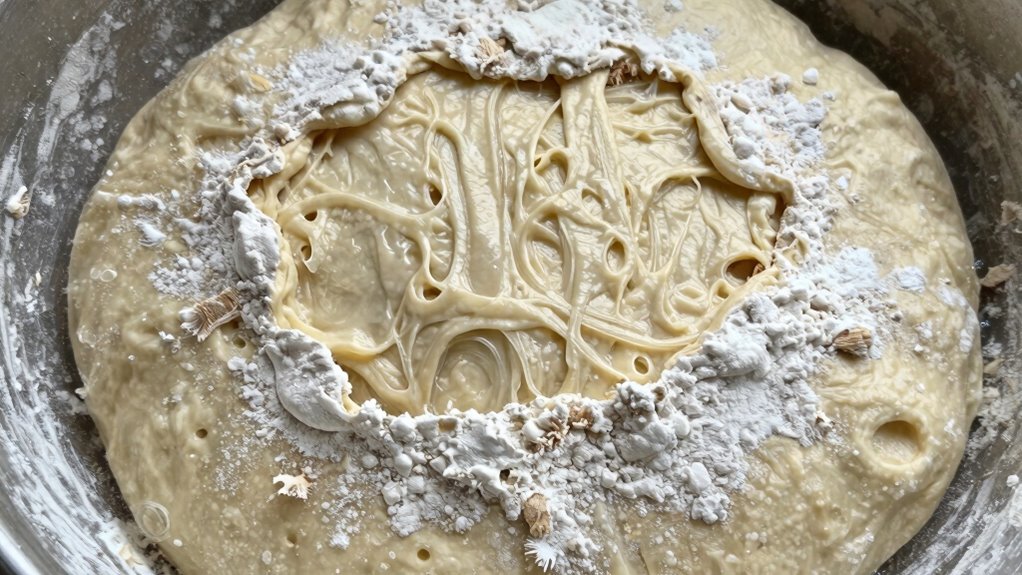
If your dough feels overly sticky and refuses to come together, it likely has too much liquid or not enough flour. Dry, crumbly dough suggests it needs more moisture or better kneading. Properly mixed dough should be elastic, smooth, and slightly tacky, while too tough or non-smooth indicates over- or under-kneading. Environmental factors also affect texture, so paying attention to these cues helps guarantee success. Continue exploring these clues to master your dough skills.
Key Takeaways
- Dough that remains sticky and refuses to come together indicates excess liquid or insufficient flour, signaling overhydration.
- Dry, crumbly dough suggests inadequate moisture or under-kneading, affecting gluten development.
- An overly stiff or tight dough may result from too much flour or insufficient hydration during mixing.
- Dough that feels overly elastic and resists shaping could be over-kneaded, leading to toughness.
- Uneven or non-smooth dough points to improper mixing, ingredient imbalance, or environmental factors affecting consistency.
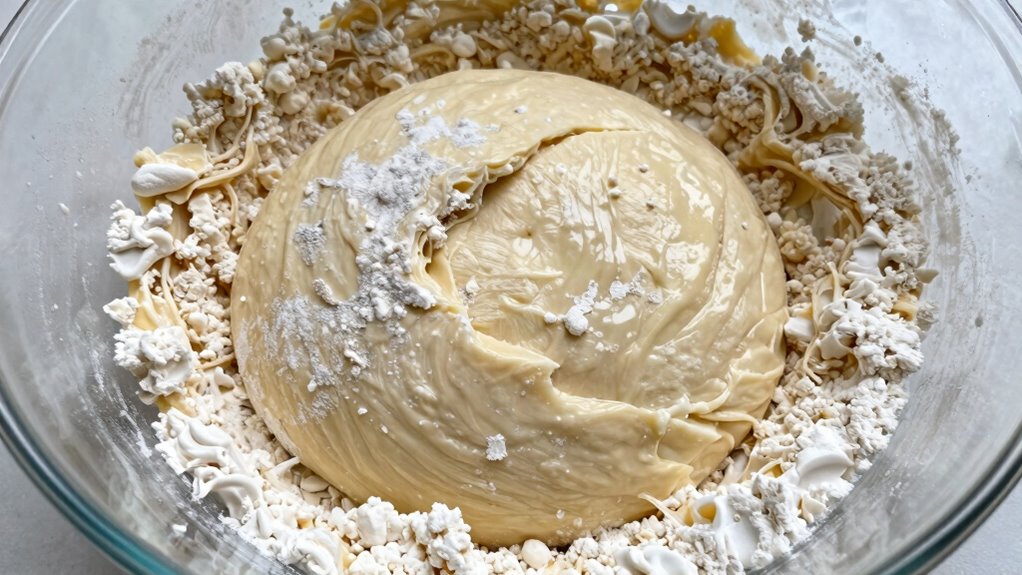
Understanding dough consistency is key to achieving perfect baked goods. When you’re mixing your dough, how it feels can tell you whether you’re on the right track or need to make adjustments. One of the most important skills you can develop is recognizing these clues early, so you don’t end up with bread or pastries that fall flat or turn out tough. Techniques for kneading are essential here because how you knead influences the final texture. If your dough feels sticky and refuses to come together, you might be adding too much liquid or not enough flour. Conversely, if it feels dry and crumbly, you probably need to incorporate more moisture or use a different technique for kneading to develop gluten without overworking the dough. Proper kneading helps develop the structure, so pay attention to how it feels during the process; it should be elastic and smooth but not sticky.
Ingredient substitution tips also play a role in dough texture. If you’re swapping ingredients, like using a different type of flour or fat, expect some change in how your dough behaves. For example, using whole wheat flour instead of all-purpose can make the dough denser and slightly drier, so you might need to add a touch more water or fat to compensate. When you’re adjusting recipes, remember that some substitutions require different techniques for kneading to achieve the right stretch and elasticity. If your dough feels overly stiff after substituting ingredients, add a small amount of liquid gradually until it reaches a pliable consistency. On the other hand, if it’s too sticky, a light dusting of flour during kneading can help, but don’t overdo it, or you risk toughening the final product. Paying attention to the dough development process can help you better control the final texture and prevent common mistakes.
Pay attention to the texture during mixing and kneading—if it remains uneven or doesn’t smooth out after a few minutes, it’s a sign to reassess your ingredients or technique. Over-kneading can make dough tough, while under-kneading prevents gluten development, resulting in a crumbly or flat baked good. Developing the right dough elasticity is crucial for good bread and pastry structure. The key is to develop a dough that’s soft, elastic, and slightly tacky but not sticky. Recognizing these clues allows you to adjust on the fly, whether by changing your kneading technique or tweaking your ingredients. Proper dough texture cues are also influenced by environmental factors, such as humidity and temperature, which can impact how your dough develops. Mastering these cues and understanding dough texture clues helps prevent mistakes and ensures consistent results. With practice, your understanding of dough texture will become intuitive, leading to a predictable and delicious outcome every time.

Winco , 8-Quart, Stainless Steel (MXB-800Q)
Stainless steel durable construction for years of work
As an affiliate, we earn on qualifying purchases.
As an affiliate, we earn on qualifying purchases.
Frequently Asked Questions
How Can I Fix Over-Mixed Dough?
To fix over-mixed dough, gently fold in a little more flour or cold butter to disrupt excess gluten formation and restore tenderness. Avoid kneading it further, as that can make the gluten tougher. Rest the dough in the refrigerator for about 15-30 minutes to help relax the gluten and improve fat distribution. This will make your dough easier to work with and yield a better texture in your final baked goods.
What Ingredients Affect Dough Texture the Most?
You’re really on the ball to ask which ingredients shape dough texture. Flour is the main player, affecting gluten development—more gluten makes the dough chewier. Fat, like butter or oil, influences its tenderness and elasticity by improving fat distribution. Water and eggs also matter, helping gluten form and creating a softer, more pliable dough. Keep an eye on these ingredients to master your dough’s perfect texture—don’t let it be a shot in the dark.
Can I Salvage Under-Hydrated Dough?
Yes, you can salvage under-hydrated dough. Increase its dough hydration by slowly adding water while kneading until it reaches the right consistency. If you’re short on a specific ingredient, consider substitution with a similar one to improve texture. Keep in mind, adjusting dough hydration and ingredient substitution helps restore elasticity and workability, making your dough more manageable and ensuring a better final baked product.
How Does Humidity Impact Dough Consistency?
Humidity impact can be a game-changer—just like a surprise rainstorm during a picnic. When humidity rises, moisture levels increase, making your dough softer and trickier to handle. Conversely, dry air can dry out your dough, leading to cracks and stiffness. To keep control, you need moisture control strategies, like adjusting flour amounts or covering your dough. Understanding humidity impact helps you maintain the perfect dough consistency, no matter the weather.
What Tools Help Assess Dough Texture Accurately?
You can use a bench scraper or your fingers to assess dough hydration and gluten development. A well-hydrated dough feels tacky but not sticky, and develops good gluten structure, making it elastic and smooth. A dough scraper helps you feel the dough’s consistency as you knead. Also, stretch test can show if gluten has developed properly; if it stretches without tearing, your dough is ready.
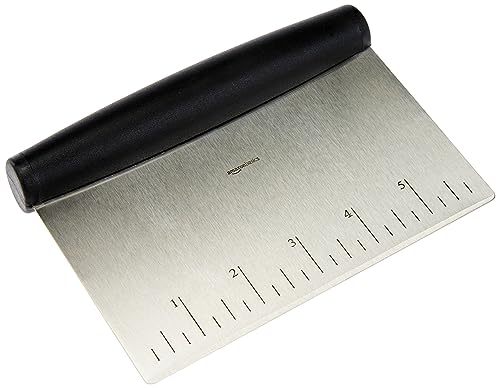
Amazon Basics Multi-Purpose Bench Scraper, Stainless Steel Dough Cutter with Measurement Marks, Dishwasher Safe, Non-slip Contoured Grip, 6", Black, Silver
Multi-purpose scraper/chopper tool for portioning bread and pastry dough, chopping and measuring
As an affiliate, we earn on qualifying purchases.
As an affiliate, we earn on qualifying purchases.
Conclusion
Your dough is like a story waiting to unfold—its texture a silent narrator revealing what’s happening beneath the surface. When it’s too sticky or too stiff, it’s whispering signs that something’s off. Trust these clues as your guiding stars, steering you toward perfect mixing. Just like a craftsman shapes raw materials into art, you mold your dough into a masterpiece by listening to its subtle signals. In every knead, you’re forging more than bread—you’re shaping confidence.

Extra Thick Silicone Baking Mat with Recipes – 26×16 inch Non Stick Pastry Mat with Measurements for Sourdough, Macarons, Bread, Pizza, Dough Rolling, Kneading, Heat Resistant to 480°F Gift for Baker
【𝐏𝐫𝐞𝐜𝐢𝐬𝐞 𝐃𝐮𝐚𝐥-𝐂𝐨𝐥𝐨𝐫 𝐏𝐫𝐢𝐧𝐭𝐢𝐧𝐠 & 𝐑𝐨𝐮𝐧𝐝𝐞𝐝 𝐄𝐝𝐠𝐞𝐬】🍪 Features high-contrast dual-color markings (inch/cm) for ultra-clear measurements, unlike cheaper single-color mats…
As an affiliate, we earn on qualifying purchases.
As an affiliate, we earn on qualifying purchases.

Etekcity Food Kitchen Scale, Digital Grams and Ounces for Weight Loss, Baking, Cooking, Keto and Meal Prep, LCD Display, Medium, 304 Stainless Steel
𝗘𝗳𝗳𝗼𝗿𝘁𝗹𝗲𝘀𝘀 𝗪𝗲𝗶𝗴𝗵𝗶𝗻𝗴: Supports 5 units (oz/lb:oz/fl'oz/g/mL), tare function, and includes 2 AAA batteries for hassle-free operation
As an affiliate, we earn on qualifying purchases.
As an affiliate, we earn on qualifying purchases.