

TL;DR

Get kitchen staples and gadgets delivered free with Prime
- Fast, free delivery on millions of items
- Prime Video, Amazon Music and more included
- Member-only deals all year
Researchers have developed Epicure, an AI system that compresses the knowledge of human cooking into a 2MB dataset. This breakthrough allows for detailed recipe and ingredient analysis across multiple languages and cultures. The development is confirmed, but its practical applications are still being explored.
Researchers have announced the creation of Epicure, an artificial intelligence system that compresses the collective knowledge of human cooking into a mere 2 megabytes of data. This development, confirmed by the study published on arXiv, represents a significant advance in culinary AI and data compression, with potential implications for recipe generation, culinary research, and cross-cultural food analysis.
The Epicure project aggregates 4.14 million recipes from 11 sources across seven languages, including English, Chinese, Russian, Vietnamese, Spanish, Turkish, Indonesian, German, and Indian-English. The system normalizes ingredient data to 1,790 canonical entries using a large language model (LLM)-augmented pipeline, enabling consistent cross-lingual analysis.
Using this data, the researchers trained three variants of skip-gram models—Cooc, Chem, and Core—that differ in their focus on ingredient co-occurrence, chemical compound relationships, and a blend of both. The models are designed to capture different aspects of culinary knowledge, from recipe context to chemical composition, within a compact, 2MB dataset.
Why It Matters
This breakthrough matters because it demonstrates the possibility of distilling vast, complex culinary knowledge into a highly compressed form, enabling advanced AI applications in food science, recipe innovation, and cross-cultural culinary understanding. The compact size facilitates deployment in resource-constrained environments and paves the way for more sophisticated AI-driven culinary tools.
Products Worth Considering
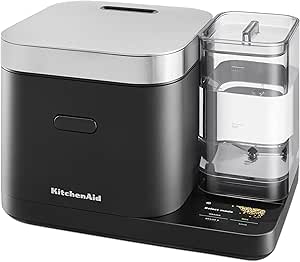
KitchenAid 8-Cup Grain and Rice Cooker with Integrated Scale, Black Matte

Le Creuset Enameled Cast Iron Round Bread Oven, 9.5-Inch, Cerise

Vitamix Propel Series 750 Professional-Grade Blender, 4 Programs, Black
As an affiliate, we earn on qualifying purchases.
Background
Prior to this, AI models trained on recipe data typically require large datasets and extensive computational resources. The Epicure project builds on recent advances in multilingual data aggregation, ingredient normalization, and graph-based embedding techniques. Its development aligns with ongoing efforts to create more efficient, interpretable AI models in the culinary domain.
“Compressing the essence of human cooking into just 2MB is a step toward more accessible and versatile culinary AI applications.”
— Josef Liyanjun Chen, lead researcher
“Our models capture different facets of culinary knowledge, from ingredient relationships to chemical compositions, within a remarkably small dataset.”
— arXiv authors
What Remains Unclear
It is not yet clear how effectively Epicure can generate new recipes or adapt to real-world culinary tasks. Practical applications and performance in diverse settings remain to be tested.
What’s Next
Next steps include deploying Epicure in culinary AI tools, testing its capabilities in recipe generation, and exploring its integration into food science research. Further validation and real-world application studies are expected in the coming months.
Key Questions
How can Epicure’s 2MB dataset be so comprehensive?
Epicure aggregates millions of recipes across multiple languages and normalizes ingredients, allowing it to capture a wide range of culinary knowledge in a compact form.
What are the potential uses of this AI model?
Possible applications include recipe creation, culinary research, cross-cultural food analysis, and resource-efficient AI deployment in kitchens and food tech.
Is this development commercially available?
No, Epicure is currently in research and development stages. Its practical deployment will depend on further testing and validation.
Does this mean AI can now fully understand human cooking?
While Epicure captures extensive culinary data, its ability to fully understand and innovate in cooking remains to be demonstrated through practical tests.
Source: Hacker News